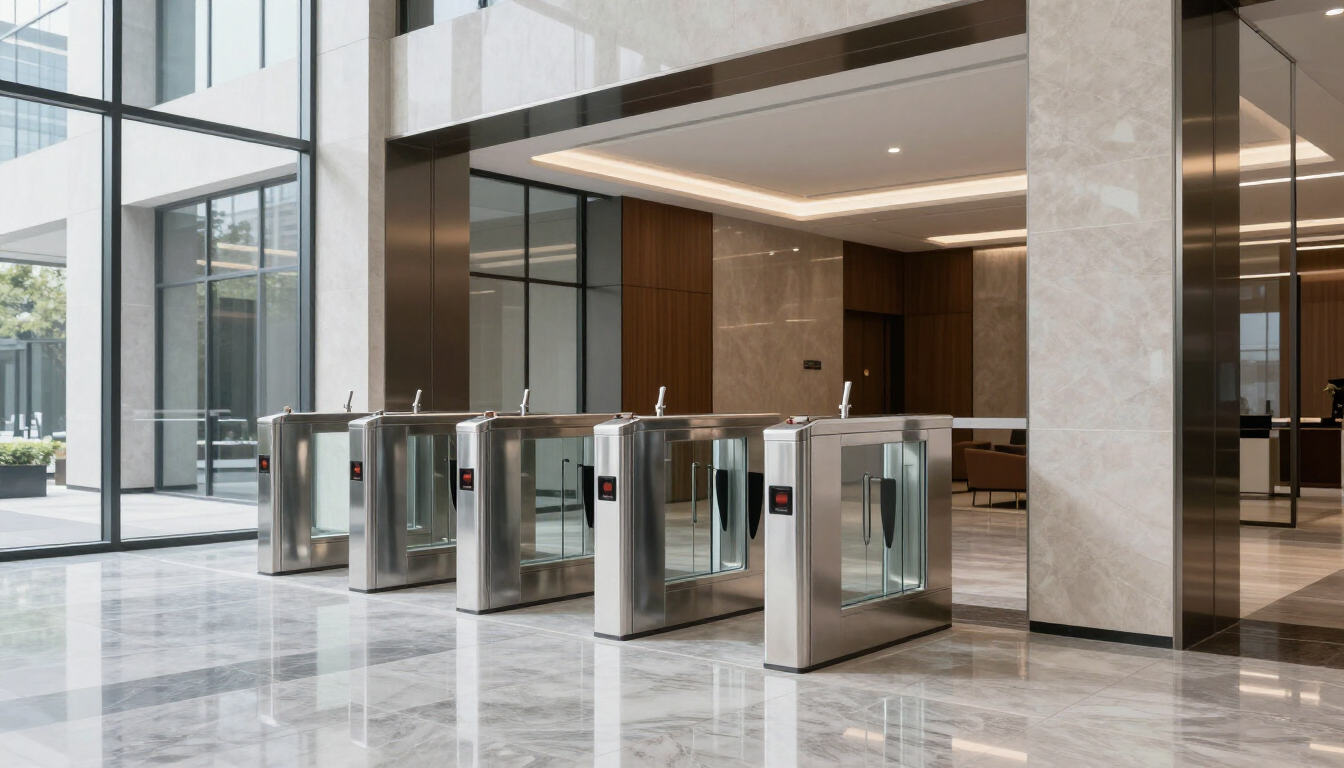

When Should a Facility Choose a Security Revolving Door? A Nationwide Planning Guide
This is a subtitle for your new post
Signs Your Facility Needs a More Controlled Pedestrian Entrance
A commercial entrance needs to welcome authorized employees and visitors while preventing people from entering without approval. In many facilities, a standard locked door or ordinary revolving door works well during normal business hours. As security needs increase, however, those entrances may no longer provide enough control over how many people pass through or whether every person has presented a valid credential.
This challenge affects secure facilities throughout the United States, including corporate offices, data centers, manufacturing plants, government buildings, laboratories, industrial properties, and high-value commercial environments. These properties may need stronger pedestrian access control without creating an entrance that looks temporary, overly industrial, or disconnected from the building’s architecture.
An ordinary revolving door can help organize pedestrian flow and reduce the amount of outside air entering a building, but it does not automatically verify who is authorized to enter. A card-controlled swing door may confirm a credential, yet someone can still hold the door for another person or allow an unauthorized individual to follow closely behind.
This type of unauthorized following is often called tailgating. It can happen intentionally, but it may also occur because employees are trying to be polite. Someone sees another person approaching and holds the door without confirming whether that person has permission to enter.
A security revolving door creates a more controlled physical passage. Instead of opening an unrestricted doorway, the system separates users into individual revolving compartments. When integrated with access-control technology, it can help regulate passage and create a more accurate relationship between approved credentials and actual entries.
Signs that a facility may need a more controlled pedestrian entrance include:
- Employees frequently hold secured doors open for other people
- Unauthorized individuals can follow approved users into the building
- Security personnel must constantly watch the entrance
- The facility needs one-person-at-a-time pedestrian passage
- Access-control records do not match the number of people entering
- The entrance must remain controlled outside staffed hours
- A standard optical turnstile does not provide enough physical separation
- A traditional barred full-height turnstile does not match the building’s appearance
- The property needs stronger control without creating an exposed industrial entrance
- Visitors, contractors, and employees currently use inconsistent entry procedures
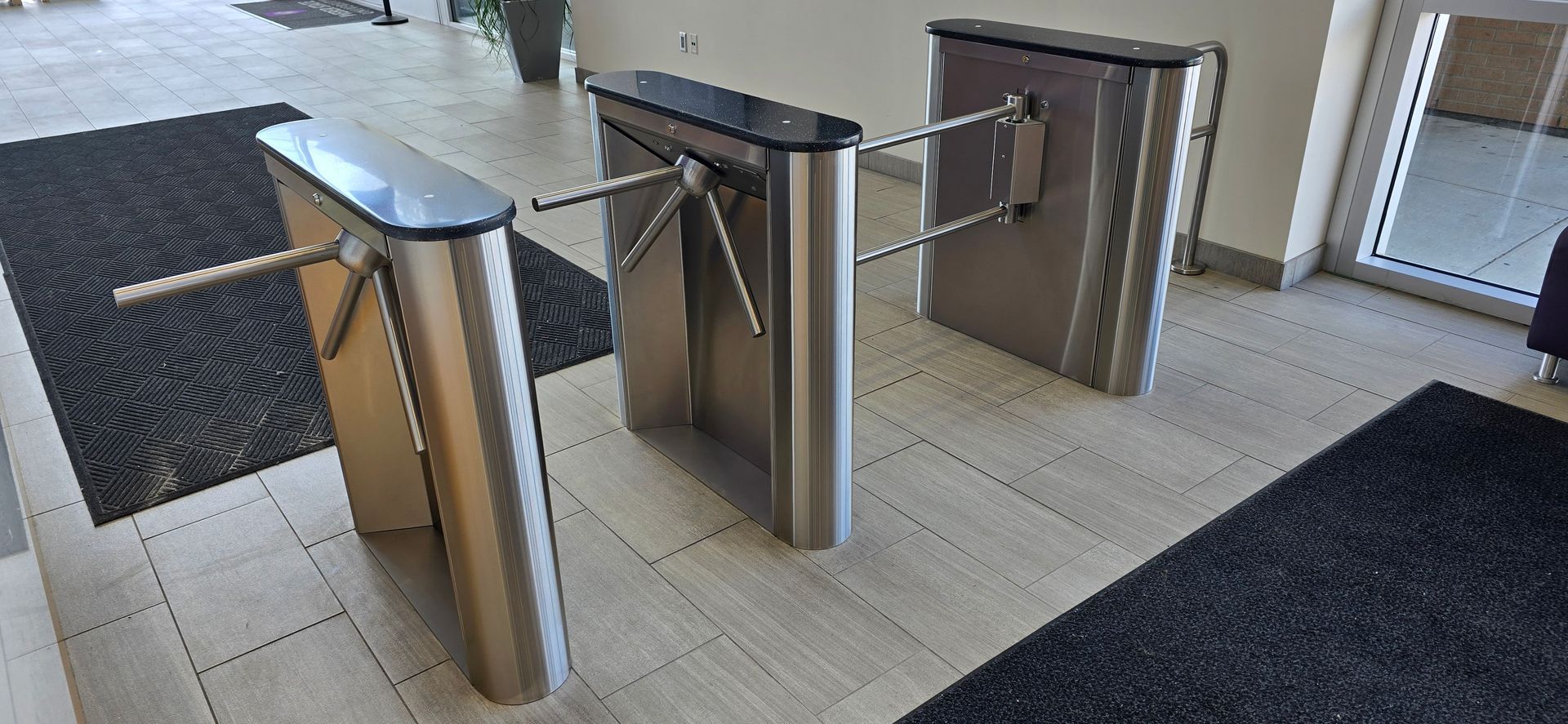
One of the most important questions is whether the existing system merely detects unauthorized passage or physically limits it. Optical turnstiles can use sensors to identify tailgating, wrong-way movement, and other exceptions. They are well suited to many office and lobby environments, but the barrier height and design may not provide the physical control required for every facility.
A full-height turnstile provides a stronger physical barrier, but its traditional metal-bar design may not be appropriate for a finished corporate lobby or architecturally sensitive entrance. Security revolving doors help fill the space between those options by providing full-height controlled passage in a more refined revolving-door format.
Facilities that may benefit from a security revolving entrance include:
- Corporate headquarters and regional offices
- Data centers and telecommunications facilities
- Manufacturing and distribution properties
- Research laboratories and technology campuses
- Government and public-sector buildings
- Industrial plants and utility facilities
- Financial institutions and high-value commercial properties
- Secure residential or mixed-use developments
- Healthcare or pharmaceutical facilities with restricted areas
- Properties that require controlled entry during unstaffed hours
Security revolving doors can be particularly useful when the entrance is visible to clients, executives, tenants, or the public. The system can provide a substantial physical barrier while maintaining glass, aluminum, and architectural finishes that coordinate with the surrounding lobby.
The entrance can also reduce dependence on constant manual supervision. Security staff may still monitor activity and respond to exceptions, but they do not need to visually approve every routine employee entry when credentials and passage rules are managed by the system.
A controlled revolving entrance may also improve access records. If one credential is accepted and the system permits one person to pass, the entry log can provide a more accurate representation of who entered the secured area. This can support incident investigations, compliance reporting, and general facility oversight.
Questions that may help determine whether the current entrance is adequate include:
- Can more than one person enter after a single credential is presented?
- Does the entrance depend heavily on employees following security procedures?
- Can security staff clearly identify who has entered during busy periods?
- Does the current system provide enough physical resistance?
- Can the entrance operate securely when no guard is stationed nearby?
- Does the equipment fit the architectural appearance of the property?
- Are access events accurately recorded and easy to review?
Security revolving doors are not automatically the right answer for every building. A facility with high pedestrian volume and moderate security needs may be better served by optical turnstiles. An outdoor industrial perimeter may require traditional full-height equipment. The correct solution depends on the risk level, traffic pattern, available space, accessibility needs, and architectural expectations.
MRKset offers security revolving-door products designed to combine full-height turnstile functionality with a more finished architectural appearance. Options such as the HT60 and HT70 can be integrated with access-control technology and selected according to the facility’s security and design requirements.
A professional entrance evaluation can help determine whether a revolving security door, optical turnstile, full-height turnstile, or another access-control configuration best fits the property. The goal is not simply to install the strongest-looking equipment. It is to create a reliable entrance that controls passage, supports normal operations, and fits the building where it will be used.

How One-Person Entry Strengthens Access Control
A security revolving door creates separate passage compartments instead of opening a wide, unrestricted doorway. Each authorized user enters an individual section of the revolving system and moves through to the secured side after presenting an approved credential.
The exact sequence depends on the selected equipment and access-control configuration, but the general process is designed to connect identity verification with controlled physical passage.
A typical security revolving-door entry may work like this:
- The user approaches the secured entrance.
- A badge, mobile credential, PIN, biometric identifier, or visitor credential is presented.
- The access-control platform verifies the person’s permissions.
- The revolving compartment is released or authorized for passage.
- The user moves through the controlled opening into the secured area.
- The system records the entry event.
- The door resets and prepares for the next authorized user.
This process helps reduce the opportunity for several people to enter through one unrestricted opening. The physical compartments create more separation than a standard swing door and can provide stronger pedestrian control than systems that rely primarily on sensors and alarms.
Security revolving doors may work with several types of access credentials, including:
- Employee identification badges
- Mobile phone credentials
- PIN or keypad entry
- Fingerprint or other biometric readers
- Temporary visitor passes
- QR-code credentials
- Contractor or vendor access permissions
- Reception-desk release controls
The selected credential should coordinate with the facility’s existing access-control platform whenever possible. This allows the revolving entrance to follow the same permissions, schedules, user groups, and reporting procedures as other secured doors throughout the property.
For example, an employee may have permission to enter during normal working hours but not overnight. A contractor may receive temporary access for a specific date. A visitor may be authorized only after completing a reception or visitor-management process. The revolving door can respond according to those rules rather than operating as an isolated piece of equipment.
Physical passage control can also help reduce casual door holding. Employees are less likely to wave another person through when the entrance is divided into controlled compartments and each user is expected to present an individual credential.
The system may also generate alarms or deny passage when access is invalid, the equipment is used incorrectly, or another exception occurs. Security personnel can review those events through the connected access-control or security-management platform.
Choosing Between Architectural Appearance and Security Features
A security entrance should be selected according to both performance and appearance. A facility should not choose a revolving door only because it looks more refined, nor should it accept equipment that disrupts the architecture simply because it provides stronger control.
The major pedestrian entrance categories provide different advantages:
- Standard revolving doors: Organize traffic and reduce air exchange but may not verify individual authorization.
- Optical turnstiles: Provide fast throughput, modern styling, and sensor-based detection for commercial interiors.
- Traditional full-height turnstiles: Create a strong physical barrier for industrial, outdoor, and high-security applications.
- Security revolving doors: Combine full-height controlled passage with glass, aluminum, and architectural finishes.
Optical turnstiles are often a strong choice for high-volume office lobbies because they allow authorized people to move through quickly. Their barriers and sensors help identify unusual activity, but the design may not provide the level of physical separation required for a data center, secure laboratory, or other controlled facility.
Traditional full-height turnstiles provide greater physical control and are commonly installed at industrial facilities, secured campuses, parking areas, and outdoor perimeters. Their exposed rotating bars are highly functional but may not complement a premium lobby or customer-facing entrance.
Security revolving doors offer an alternative for properties that want stronger full-height control in a finished enclosure. Depending on the model, design options may include:
- Clear or solid sidewalls
- Framed or frameless glass panels
- Aluminum architectural construction
- Roof canopies or finished overhead structures
- Noise-reduction features
- Different compartment and passage configurations
- Credential-reader and biometric integration
- Finishes selected to complement the surrounding entrance
MRKset’s HT60 provides full-height controlled passage in a relatively streamlined architectural design. It may fit facilities that need a strong pedestrian barrier while maintaining a clean, professional appearance.
The HT70 offers a more premium revolving-glass presentation and may be appropriate for entrances where architectural impact and advanced security features are both priorities. The correct option depends on the opening, design expectations, security level, and operational requirements.
Traffic volume must also be considered. A controlled revolving compartment generally moves people differently than a bank of open optical lanes. Facility managers should understand how many employees enter during shift changes, morning arrival periods, or scheduled events.
Important selection factors include:
- The required level of physical security
- Expected pedestrian volume
- Lobby and architectural design
- Available floor and ceiling space
- One-way or two-way operation
- Credential and biometric requirements
- Visitor and contractor procedures
- Accessibility and delivery needs
- Emergency-egress planning
- Interior or exterior installation conditions
The revolving entrance should also be evaluated as part of the complete facility. Nearby reception desks, security stations, elevators, stairways, accessible gates, and secondary doors all affect how people move through the area.
MRKset provides a broad selection of entrance-control systems, including optical turnstiles, waist-height equipment, full-height turnstiles, security revolving doors, vehicle-access systems, and related access-control technology. This allows the entrance design to begin with the facility’s needs instead of forcing one type of equipment into every application.
A successful system should provide the required level of control while remaining practical for the people who use it every day. The best security entrance is one that employees understand, visitors can navigate, staff can manage, and the organization can rely on over the long term.

What Should Facility Managers Evaluate Before Installation?
Installing a security revolving door requires coordination between security planning, architecture, construction, electrical work, access-control technology, pedestrian flow, and emergency procedures. It should not be treated as a simple equipment replacement.
The planning process should begin with a site assessment. The project team needs to understand the existing opening, surrounding walls, floor structure, ceiling height, available power, network connections, and the way people currently approach and leave the entrance.
Important site and operational factors include:
- Entrance width, depth, and ceiling height
- Floor construction and anchoring conditions
- Expected pedestrian volume during peak periods
- Required entry and exit directions
- Credential-reader and biometric-device placement
- Nearby reception and security desks
- Available electrical power and data connections
- The existing access-control platform
- Emergency release and evacuation requirements
- Accessible entry for wheelchairs and mobility devices
- Movement of carts, tools, luggage, and deliveries
- Interior climate and exterior weather exposure
Pedestrian traffic should be studied carefully. An entrance that performs well during normal hours may create congestion during shift changes or morning arrival periods. Facility managers should estimate how many users need to enter within a short period and whether additional lanes or another entrance type should operate beside the revolving door.
Questions to answer during planning include:
- How many people use the entrance during peak periods?
- Will security personnel be stationed nearby?
- Which credentials will employees and visitors present?
- Is one-way or two-way controlled passage required?
- How will visitors, vendors, and contractors enter?
- Is a separate ADA-accessible gate or controlled door needed?
- How will carts, tools, luggage, and large deliveries move through the entrance?
- What happens when electrical power is lost?
- How should the equipment respond when the fire alarm activates?
- Does the system need to match existing lobby finishes?
- Will the entrance operate during unstaffed hours?
Accessibility must be included in the original design. A security revolving compartment may not accommodate every wheelchair, mobility device, delivery cart, or oversized item. The facility may need an integrated full-height gate, swing gate, or another controlled route beside the revolving entrance.
That companion opening should not become an unsecured bypass. It can be connected to the same access-control platform, credential readers, permissions, alarms, and reporting used by the primary entrance.
Full-height gates can provide a wider clear opening for wheelchairs, carts, strollers, tools, luggage, and other items that do not fit comfortably through a standard turnstile. The accessible route should remain easy to locate and should not require users to travel through an unrelated service area.
Emergency operation is another critical planning area. The project team should coordinate the revolving entrance with the building’s approved egress strategy, fire-alarm system, power-loss response, manual release controls, and backup power where appropriate.
The exact configuration depends on the facility and applicable requirements. Security and life-safety systems should be reviewed together so that controlled entry does not interfere with required emergency evacuation.
A security revolving-door project may follow these steps:
- Conduct a site assessment and document existing conditions.
- Define security, traffic, accessibility, and architectural goals.
- Select the appropriate revolving-door and companion-gate configuration.
- Develop drawings, equipment schedules, and technical specifications.
- Coordinate floor, wall, ceiling, electrical, power, and data requirements.
- Install the revolving door, readers, controls, and surrounding equipment.
- Program credentials, schedules, alarms, and operating rules.
- Test normal entry, access denial, emergency response, and system reporting.
- Train security, facilities, and administrative personnel.
Detailed drawings help contractors understand the required openings, anchoring, conduit, electrical connections, and equipment placement before installation begins. This can reduce conflicts between the entrance-control equipment and surrounding construction.
Credential readers should be placed where users can approach naturally without blocking adjacent traffic. Cameras, intercoms, visitor devices, and biometric readers may also need to be coordinated with the revolving door and security station.
After installation, professional commissioning should verify that the completed system performs as intended. Testing should include:
- Valid and invalid employee credentials
- Visitor and temporary access permissions
- Normal rotation and passage
- Access denial and alarm conditions
- One-way and two-way operating modes
- Entry-event logging
- Power-loss behavior
- Emergency release and fire-alarm response
- Companion accessible gates and controlled doors
- Communication with the facility’s access-control platform
Nationwide Security Revolving-Door Installation
MRKset provides commercial entrance-control planning, equipment, engineering, integration, and installation support for facilities throughout the lower 48 states. Projects can be coordinated for corporate, industrial, government, technology, healthcare, educational, and other secured environments.
Available entrance-control solutions may include:
- Security revolving doors
- Optical turnstiles
- Waist-height turnstiles
- Full-height turnstiles and gates
- Vehicle access-control systems
- Badge, mobile, biometric, and visitor credential integration
- Access-control software and system integration
- CAD and engineering support
- Nationwide installation coordination
- System testing, commissioning, and staff training
MRKset’s design and engineering capabilities help facilities move from an initial security concern to a coordinated entrance plan. The team can review the site, recommend suitable equipment, develop project documentation, and help coordinate installation requirements with contractors and other trades.
This support is particularly valuable for organizations managing projects across multiple facilities or states. Equipment standards, credential procedures, reporting expectations, and architectural requirements can be coordinated while still accounting for the conditions at each site.
A security revolving door can provide a strong combination of physical control, access verification, entry records, and architectural design. Its success, however, depends on selecting the right model and integrating it properly with the facility around it.
If your organization needs stronger pedestrian control but does not want a traditional industrial turnstile at the primary entrance, contact MRKset. A professional project review can help determine whether a security revolving door fits the facility’s risk level, pedestrian traffic, access-control platform, and design goals.
With careful engineering, installation, and testing, a revolving security entrance can become a dependable part of the building rather than a stand-alone obstacle. It can protect the secured area while providing an entrance that looks intentional, professional, and appropriate for the people who use it every day.
Recent Posts